Carp Fishing in California: Chumming Rules, Waters & Bait
Last updated: October 27, 2026 · Written by Erni, World Classic Baits
In California, your usual carp method can break the law. Chumming is banned in most inland waters, you fish one rod unless you buy a validation, and river rigs have their own spacing rule. This guide covers the 2026 rules from the California Department of Fish and Wildlife (CDFW). It also shows where state documents point to carp, and what the rules mean for your bait.
The short version
- Chumming is allowed in only four areas: the Colorado River District, Carquinez Strait and Suisun Bay, and the lower Sacramento and San Joaquin rivers.
- One rod by default. A second rod needs a Second-Rod Validation ($20.26 in 2026).
- No limit and no season on common carp, day or night, with a few local exceptions.
- Grass carp must go back unharmed, except in parts of Siskiyou and Shasta counties.
- The state record is 52 lb, from Lake Nacimiento in 1968.
Is California good for carp fishing?
It has a claim to being where American carp began. The U.S. Geological Survey notes there is “some question” about when carp first arrived. One account it cites dates it to 1872, when J. A. Poppe of Sonoma imported five fish from Germany.
The official record is old. CDFW lists a 52 lb carp from Lake Nacimiento in San Luis Obispo County, caught by Lee Bryant of Fresno on 04/01/1968, on a lure. Bigger fish have been reported since. In 2026, MeatEater described a 64.22 lb common carp from an unnamed California lake as an “unofficial” U.S. record. It does not appear on CDFW’s list.
Is chumming legal in California?
Only in four areas. CDFW defines chumming as “placing any material in the water, other than on a hook while angling, for the purpose of attracting fish.” The 2026 Freshwater Sport Fishing Regulations then state: “Chumming is permitted only in” these waters.
| Where chumming is allowed | What you can chum with |
|---|---|
| Colorado River District | Only the approved bait fishes for that district |
| Salton Sea (Colorado River District) | Approved bait fishes, and corn |
| Carquinez Strait and Suisun Bay | Including their tributaries and saltwater tributaries |
| Sacramento River | Downstream from the Interstate 80 bridge, including tidewater of tributaries |
| San Joaquin River | Downstream from the Interstate 5 bridge, including tidewater of tributaries |
What this means for carp anglers. Outside those areas, throwing loose corn, pellets or groundbait into your swim counts as chumming. Bait on the hook is fine everywhere bait is allowed. CDFW’s text does not say whether groundbait packed around a method feeder counts as “on a hook.” Ask CDFW before you rely on it.
The Salton Sea is the stand-out exception: it is the only inland water where the rules name corn as legal chum. In the Sacramento-San Joaquin Delta below the I-80 and I-5 bridges, a normal carp approach with groundbait and corn is allowed.
Where can you catch carp in California?
Common carp live across the state, but CDFW does not publish a list of carp waters. These are the waters where state documents mention carp directly.
| Water | Why it’s on the list |
|---|---|
| Lake Nacimiento (San Luis Obispo Co.) | State record carp, 52 lb, 1968 |
| Salton Sea | The only inland water where corn is legal chum |
| Sacramento-San Joaquin Delta | Chumming allowed below the I-80 and I-5 bridges |
| Carquinez Strait and Suisun Bay | Chumming allowed |
| Lake Havasu (San Bernardino Co.) | State health agency OEHHA has a carp-specific eating advisory |
| Clear Lake (Lake Co.) | OEHHA lists common carp in its Clear Lake eating guide |
Looking for carp in a new water? Our step-by-step guide on how to fish for carp explains where they hold in lakes and rivers.
Do you need a license to fish for carp in California?
Yes, from age 16. CDFW sells the resident sport fishing license to “any resident 16 years of age or older.” Most fees include a 5% agent handling fee and a 3% application fee.
| License | Price (2026) |
|---|---|
| Resident annual | $64.54 |
| Non-resident annual | $174.14 |
| 1-day (resident or non-resident) | $21.09 |
| 2-day (resident or non-resident) | $32.40 |
| 10-day (non-resident) | $64.54 |
| Second-Rod Validation | $20.26 |
Free Fishing Days. California has already set its 2027 Free Fishing Days: Saturday, July 3, and Saturday, September 4. No license is needed on those days, but all other rules still apply.
What are the carp fishing rules in California?
Carp has no species section of its own in the regulations. It falls under “other species,” which “may be taken in any number and at any time of the year by angling,” except where district rules say otherwise.
| Question | California rule |
|---|---|
| Limit and season | Any number, all year, unless a district rule says otherwise |
| How many rods? | One closely attended rod. Two with a Second-Rod Validation, or if you’re under 16. Not on artificial-lure or barbless-hook waters |
| Night fishing | Allowed day or night, with exceptions such as parts of the American River, Mono County and Lake Tahoe |
| Chumming | Only in the four areas above |
| Bait | “Treated and processed foods” are allowed. Fish as bait depends on the district |
| Grass carp | May not be kept. Return it unharmed. Exception: Siskiyou and Shasta counties above Lake Shasta, where it must be killed and reported |
| Bowfishing | Legal for carp all year, except in designated salmon spawning areas |
| Gaffs | Banned in inland waters, with one Sacramento River boat exception |
Caught a grass carp? In most of California, the rule is that any grass carp “inadvertently taken must be immediately returned unharmed to the water.” In the Sacramento River drainage above and including Lake Shasta, it’s the opposite. The fish must be killed and the angler must notify CDFW within 24 hours. Our USA carp guide shows how to tell grass carp from common carp.
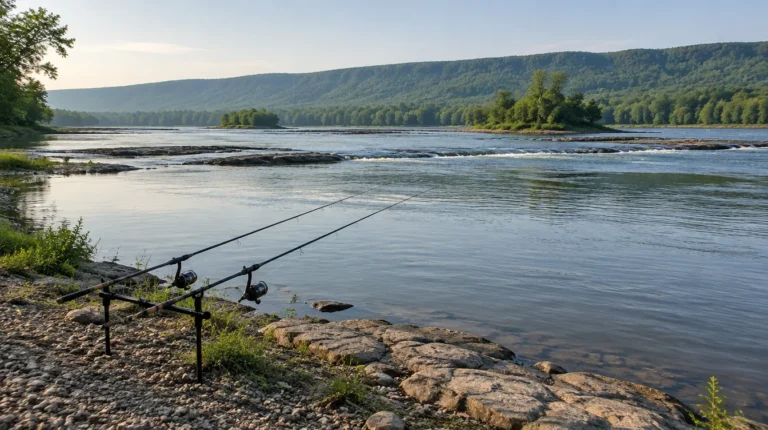
How should you rig for carp on a California river?
Keep your lead well away from the hook. The rule for rivers and streams is strict. CDFW says “it is unlawful to use any hook which is directly or indirectly attached closer than 18 inches to any weight exceeding 1/2 ounce.” You also can’t attach a weight directly below a hook, and single hooks are limited to a 1-inch gap.
- Where it applies: rivers and streams. It does not apply to lakes and reservoirs, the Sacramento-San Joaquin Delta or the Colorado River. The Delta has its own hook-gap limits.
- Why it matters: a short hooklink with a heavy lead, common in carp fishing, breaks this rule on a river.
- The fix: lengthen the hooklink to 18 inches or more, or use a lead of 1/2 oz or less.
What bait works for carp in California?
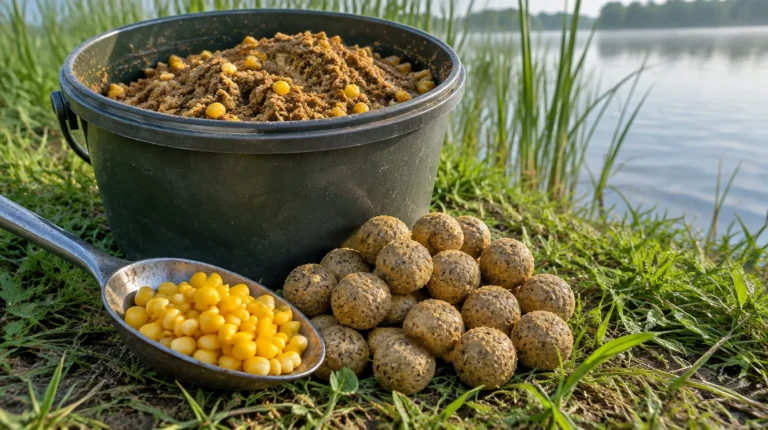
Because loose feeding is banned in most waters, the hookbait does most of the work. Corn, dough baits and boilies all count as processed food baits. Boilies are hard baits built to last on the hook. That matters when you can’t top up the swim.
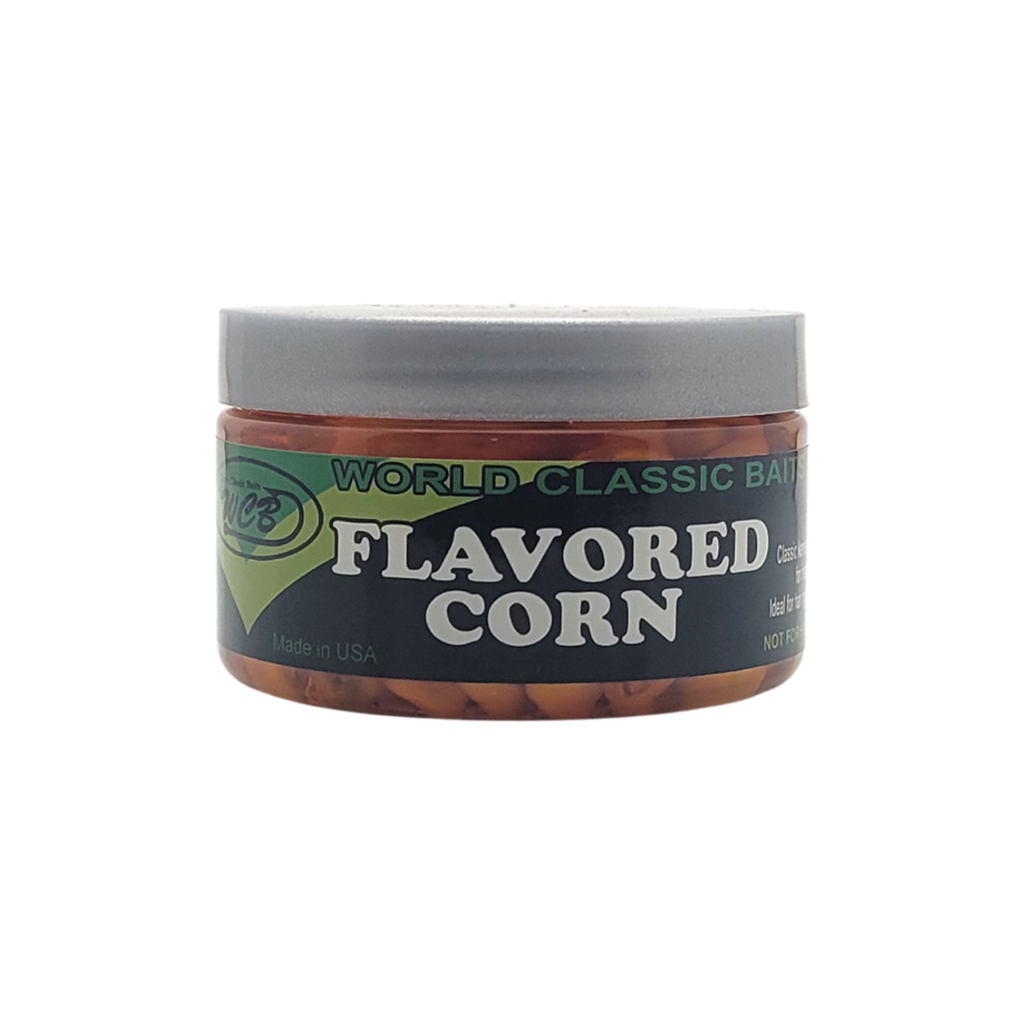
- Most waters (no chumming): Flavored Corn or a 16mm boilie on the hook, plus a bait attractant on the hookbait itself.
- Delta, Carquinez, Suisun and the lower Sacramento and San Joaquin: the full approach. Feed with Erni’s Method Mix and corn, then fish a hookbait over it.
- Salton Sea: corn is named as legal chum, so feed corn and fish corn or a boilie over it.
Not sure which bait to pick? Our guide to the best bait for carp matches baits to what carp eat in the wild.
Can you eat carp from California waters?
Be careful. The state’s Office of Environmental Health Hazard Assessment (OEHHA) covers lakes and reservoirs without their own advice. It says women 18-49 and children 1-17 should not eat common carp. Women 50 and older and men 18 and older may eat one serving a week.
Some waters have their own advice. At Lake Havasu, OEHHA allows up to four servings a week of common carp for everyone, based on selenium. Clear Lake has its own guide too. Check OEHHA for your water before you keep a fish.
Frequently asked questions
Is it legal to chum for carp in California?
Only in four areas. They are the Colorado River District (with corn allowed at the Salton Sea), Carquinez Strait and Suisun Bay, the Sacramento River below the I-80 bridge, and the San Joaquin River below the I-5 bridge. Everywhere else inland, chumming is not permitted.
How many rods can you fish in California?
One closely attended rod. With a Second-Rod Validation ($20.26 in 2026), or if you’re under 16, you can fish two in inland waters. Waters limited to artificial lures or barbless hooks stay at one rod.
What is the California state record carp?
CDFW lists a 52 lb carp caught by Lee Bryant at Lake Nacimiento on 04/01/1968. A heavier fish of about 64 lb was reported in 2026 from an unnamed lake, but it is not on CDFW’s record list.
Do I have to release a grass carp in California?
In most of the state, yes. It must go back unharmed right away. In the Sacramento River drainage above and including Lake Shasta, you must kill it instead and report it to CDFW within 24 hours.
About the author
Erni is the bait maker behind World Classic Baits, which has made groundbaits, boilies, and pellets for carp in the USA since 2008. Every recipe is tested in real fishing sessions before it reaches you.
Sources
- CDFW – 2026 California Freshwater Sport Fishing Regulations (updated July 10, 2026)
- CDFW – Fishing and diving records
- CDFW – Sport fishing licenses and report cards
- CDFW – Free Fishing Days
- OEHHA – Eating fish from California lakes and reservoirs without site-specific advice (2021)
- OEHHA – Health advisory for eating fish from Lake Havasu (2017)
- USGS NAS – Common carp species profile
- MeatEater – “The Official Unofficial U.S. Common Carp Record” (June 2026)
Rules, fees and advisories were read on 10/27/2026. California updates its regulations during the year – confirm with CDFW before you fish.