
Carp Fishing in the USA: Where to Go, When and What Bait
Five different fish get called “carp” in America. Only one of them takes a boilie. Tell them apart in seconds, know what your state says before you unhook one, and fish the water temperature instead of the calendar.
The short version
- Barbels settle it. Common carp has them. None of the four invasive carp species does.
- Common carp is not an “invasive carp” under the federal definition, and it lives in nearly every state.
- Your state decides what happens next. Indiana and Texas require you to kill an invasive carp. Illinois, Minnesota and Missouri let you put it straight back.
- Texas holds more IGFA carp records than any other state – 36 of the 116 set in the USA.
- Water temperature beats the calendar. Digestion runs five times faster at 80 °F than at 48 °F.
Which carp did you just catch?
Look at the mouth. Common carp is the only one with barbels – the short whisker-like feelers on the upper jaw. The four invasive species have none, so that single check does most of the work.
“Invasive carp” is a specific term, not a synonym for “carp.” The Invasive Carp Regional Coordinating Committee applies it to four species: bighead, black, grass and silver carp. The same page lists common carp among the fish that get mistaken for them.
| Species | Barbels | Quickest tell | Eats | Takes boilies? |
|---|---|---|---|---|
| Common carp | Yes | Big round scales, barbels on the upper jaw | Bottom insects, detritus, snails | Yes |
| Grass carp | No | Short dorsal fin, 7-8 rays; eye centered on a flat head | Plants – up to its own body weight daily | Rarely. Corn works better |
| Silver carp | No | Eyes sit below the mouth and point down; scaleless head | Filters plankton | No |
| Bighead carp | No | Dark blotches on the sides, jutting lower jaw | Filters zooplankton | No |
| Black carp | No | Near-black, pointed head, molar-like throat teeth | Snails and mussels | No |
One wrinkle worth knowing. Federal fact sheets describe “a single barbel at each corner of the mouth,” while state agencies in Florida and North Carolina describe two pairs on the upper jaw. Either way the answer at the bank is the same: barbels mean common carp.
Common carp has been here a long time. The U.S. Fish Commission began importing it from Germany in 1877 and stocked it nationwide for two decades, sometimes releasing fish straight from railroad tank cars into rivers. Today it is recorded in all 50 states.
Can you legally put it back?
For common carp, yes, in every state we checked. It is a rough fish with no bag limit. For the four invasive species, the answer changes at the state line – and it changes in both directions.
| State | Invasive carp (bighead, black, silver, grass) | Common carp |
|---|---|---|
| Indiana | Must be killed immediately – behead, cut gills or gut it. Grass carp is not on that list | No bag or size limit |
| Texas | May not be possessed alive. But on waters under a Triploid Grass Carp Permit, grass carp must be returned to the water unharmed | No statewide bag or length limit |
| Illinois | No live possession, but the fish may be immediately returned unharmed | Explicitly exempt – live possession allowed |
| Missouri | Only black carp is prohibited. The rest may be possessed in any number | Any number |
| Minnesota | Prohibited species, but a fish caught while angling and immediately returned to the same water is an exception in statute | Regulated, not prohibited |
Check this before every season. Fishing digests are reissued annually and these rules move. The Illinois guide above expires 03/31/2027, the Texas one 08/31/2027, and Indiana’s page was last updated 02/19/2026. One phone call to your state agency beats a citation.
Black carp is the one case with a single federal answer. The ICRCC “Keep, Cool, Call” guidance states plainly: “Live possession of black carp is illegal.” Keep the fish on ice, photograph the head and mouth, note your GPS position and call your state agency. There is a $100 bounty per fish across 27 state agencies – and fewer than 1% of the nearly 1,000 fish collected under it came from recreational tackle.
Where do you catch carp in the USA?
Three states stand out once you look at the record books rather than at forum opinion.
Texas leads on volume. Of the 116 IGFA common carp records set in the United States, 36 come from Texas – more than any other state. The pace is rising, not falling: 14 of them were set between 2021 and 2026. Austin alone accounts for nine, spread across Lady Bird Lake, Walter E. Long Lake and Lake Austin. The state record, 43.75 lb from Lady Bird Lake in 2009, came on maize.
Connecticut produces the heaviest fish right now. Lake Zoar gave up a 58 lb common carp in 2025, the current state record per CT DEEP. Lake Lillinonah holds two current IGFA records of its own.
New York is the best documented. NYSDEC publishes a carp map covering nine regions, with access notes and expected size. The Hudson River is called out as “the only water in the Region with much opportunity to catch large (>30 lb) carp.” Cuba Lake holds carp “up to 40 pounds,” and Meadow Lake in Queens produced the highest carp count of any DEC survey in New York City.
For scale on what is realistic: the IGFA all-tackle world record is 75 lb 11 oz, set at Lac de St. Cassien in France in 1987 and still standing. The heaviest US entry in the same book is 57 lb 13 oz from the Potomac River.
When do carp actually feed?
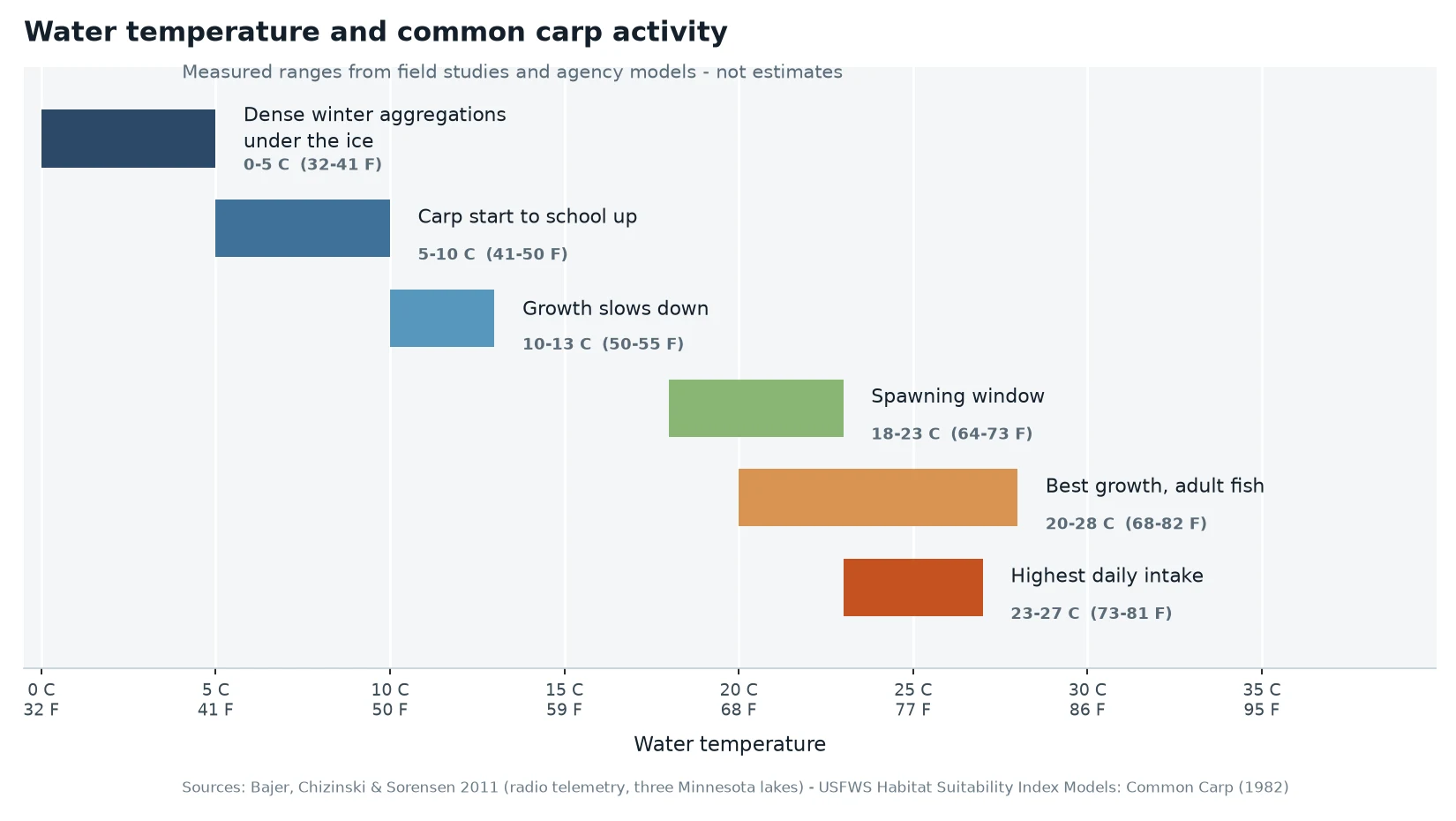
Fish the thermometer, not the month. Temperature drives how fast a carp digests, and digestion drives how often it eats.
A field study by Garcia and Adelman measured gut evacuation at 6.0% per hour at 48 °F and 32.7% per hour at 80 °F. Daily intake went from 0.39% of body weight in April to 4.08% in August – a tenfold swing driven almost entirely by water temperature.
Two pieces of common advice do not survive the data.
The first is “fish dawn and dusk.” Garcia and Adelman found no statistically significant peak feeding time of day across a full season of in-situ measurements.
The second is “in winter, find the deepest, warmest water.” Radio and acoustic telemetry across three Minnesota lakes found the opposite. Carp aggregate as water drops below 50 °F, pack in tight below 41 °F, and then sit about five feet under the ice – rarely descending into the warmer water that extended down to 30 feet.
What bait actually catches American carp?
Look at what the record books list, not at what sells. In the Texas Parks & Wildlife record tables, the baits recorded next to carp are maize, bread and “Fake Corn.” Nothing exotic.
That matches how these fish feed. Common carp works the bottom for insect larvae, snails and detritus, so a bait that sits in the silt and leaks attractant outfishes one that looks impressive in the bag.

- Corn is the entry point and it is on the record list for a reason. Start with Flavored Corn or Jumbo Corn.
- Groundbait holds fish in your swim once they arrive. Erni’s Method Mix is where most of our customers start.
- Boilies pick out the bigger fish and shrug off nuisance species. See the boilie range.
- Pellets build a feeding area fast. Active Pellets break down and pull fish in.
One practical consequence of species ID. Grass carp is a plant eater that can put away up to its own body weight in vegetation each day. If grass carp is what swims in your water, corn will out-fish a high-protein boilie most days. More on technique and species in our carp fishing guides. New to this? Our guide to carp bait for beginners covers what to buy first.
Frequently asked questions
Is common carp an invasive species in the United States?
Not under the federal term. The ICRCC applies “invasive carp” to bighead, black, grass and silver carp, and names common carp among the species people confuse with them. Common carp is non-native and long established, and it appears in all 50 states.
Do I have to kill an invasive carp if I catch one?
It depends on your state, and the answer genuinely goes both ways. Indiana and Texas require the fish to be killed before possession. Illinois, Minnesota and Missouri allow an immediate release back into the same water. Black carp is the exception with one federal answer: keep it, cool it, call your state agency.
What is the biggest carp ever caught?
The IGFA all-tackle record for common carp is 75 lb 11 oz, taken at Lac de St. Cassien in France on 05/21/1987. Heavier fish circulate online, but as of 09/21/2026 nothing larger appears in the IGFA record database.
What water temperature is best for carp fishing?
Feeding peaks between roughly 73 and 81 °F, and adult growth is best between 68 and 82 °F. Carp still feed in cold water, just far more slowly – digestion at 48 °F runs about five times slower than at 80 °F.
Which state is best for carp fishing in the USA?
Texas has produced the most IGFA records, 36 of the 116 set in the country, with Austin as the hub. Connecticut is producing the heaviest current fish, including a 58 lb state record from Lake Zoar in 2025. New York offers the best published maps through NYSDEC.
Sources
- Invasive Carp Regional Coordinating Committee – FAQ
- USGS – What are Invasive Carp?
- USGS NAS – Common Carp species profile
- Indiana DNR – Aquatic invasive species possession rules
- Texas Parks & Wildlife – Exotic aquatic species
- 2026 Illinois Fishing Regulations
- Missouri Department of Conservation – Carp
- Minn. Stat. § 84D.05
- NYSDEC – Carp fishing in New York
- CT DEEP – Freshwater record fish
- USFWS – Habitat Suitability Index Models: Common Carp (1982)
- Bajer, Chizinski & Sorensen (2011), Fisheries Management and Ecology 18(6): 497-505, doi:10.1111/j.1365-2400.2011.00805.x
- Garcia & Adelman (1985), Journal of Fish Biology 27(4): 487-493, doi:10.1111/j.1095-8649.1985.tb03196.x
Regulations were read on 09/21/2026 and change from season to season. Always confirm the current rules with your state agency before you fish.


